



Indoor air purifiers have become increasingly popular in recent years, and it’s not hard to see why.
Air pollution was once seen as an outdoor problem. However, heightened health awareness since the pandemic, worsening environmental pollution, and a greater shift to indoor living have drawn more attention to the quality of air in our homes, offices, and other living spaces.
Yet, even as the global home air purifier market is expected to grow from US$9.10 billion in 2025 to US$13.68 billion by 2032, many consumers still don’t fully understand how indoor air purification systems work, what the various technical terms mean, or how to assess competing claims.
With that in mind, here’s what to know if you’re considering purchasing an indoor air purifier.
How Do Indoor Air Purifiers Work?
At the most basic level, air purifiers clean polluted air by removing or neutralising airborne contaminants. And they do this by drawing air from a room into a unit, forcing that air through a series of filters that trap or neutralise pollutants, and then releasing the filtered air back into the room with the aid of fans.
Most portable air purifiers pull in polluted air from the sides or rear of the device and release purified air from the top. This improves circulation, ensures that contaminants are gradually removed, and provides greater room coverage.
But while general operations tend to be similar, it’s important to remember that air purification systems incorporate various technologies and components, each with distinct functions.

Here’s a closer look at some of these:
What are the Key Components and Technologies of Indoor Air Purifiers?
- Pre-Filter — The first line of defence, pre-filters function like a sieve, attracting and trapping large, visible particles, such as dust, hair and lint. By catching big airborne particles, the pre-filter can reduce the load on other components in the air purifier.
- Main Particle Filter —Once air passes through the pre-filter, it reaches the main particle filter, where most of the cleaning takes place. These filters come in various forms. However, HEPA (High Efficiency Particulate Air) filters, which are designed to remove up to 99.97% of airborne particles as small as 0.3 microns, are the gold standard.
HEPA filters are highly effective at trapping dust, pollen, pet dander, and mould spores. However, it’s worth noting the differences between “True HEPA” and “HEPA-type” filters, as well as the different HEPA grades. Essentially, “True HEPA” means the filter meets official standards, while “HEPA-type” filters are uncertified, and usually only capture between 90%-95% of particles. In terms of grades, meanwhile, higher numbers (e.g., H13 and H14) denote higher filtration efficacy. - Activated Carbon Filter — While main particle filters are effective against most solid airborne particles, they’re ineffective against gases. That’s where Activated Carbon Filters come in. Made from highly porous carbon material, these filters adsorb odours, smoke, and volatile organic compounds (VOCs), i.e., gaseous chemicals released by everyday products like cleaning products, cooking oil, and paint. This makes them useful for improving air freshness.
- Ionic Technology — Generally available in two varieties, namely ionisers and electrostatic precipitators, ionic systems release negative ions, which attach to airborne contaminants, causing them to clump together. While available as stand-alone systems, ionic purification is often used together with other technologies. It’s important, however, for consumers to look at certifications, as poorly designed ionic systems can produce ozone.
- UV-C — In tandem with particle filters, most modern air purifiers also use ultraviolet light (UV-C) to neutralise bacteria and viruses. Mainly emitted from UV lamps inside devices, the high-energy, short-wavelength light acts like a germicide by damaging the DNA and RNA of bacteria and viruses, preventing them from reproducing.
- Sensors and Smart Features — Many modern air purifiers include built-in air quality sensors. These “smart” air purification components enable devices to adjust fan speeds and operating modes in response to changes in pollution levels, thereby optimising performance and reducing energy use.
Real World Performance
Taken individually, all the highlighted technologies and components fulfil important functions. However, real-world performance depends heavily on how everything works together.
For consumers, this means also considering factors such as room coverage, maintenance needs, ease of use, and safety.
One product designed with this kind of practical approach in mind is the HomePure Zayn from QNET.
HomePure Zayn: A Comprehensive Approach to Air Purification
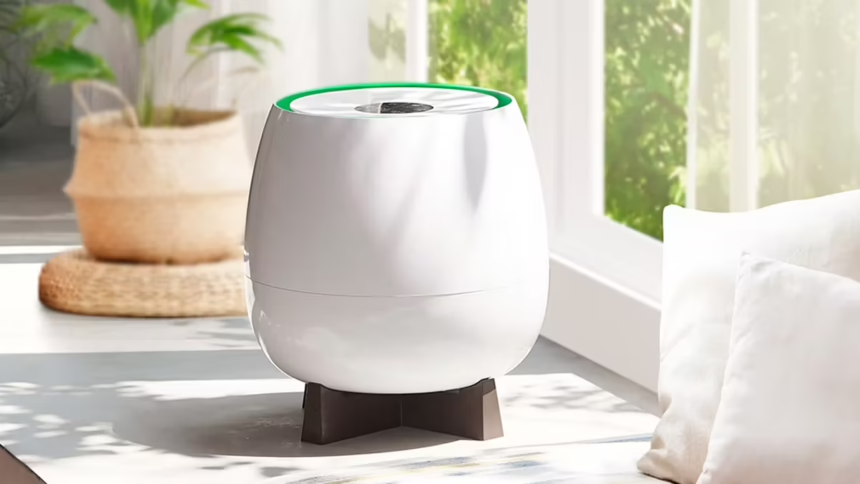
Developed in Switzerland and manufactured in South Korea, the HomePureZayn is a compact, lightweight and powerful home air purifier that combines various technologies and introduces cutting-edge filtration approaches in a single unit.
For a start, while most home air purifiers use a combination of two or three filtration stages, the HomePure Zayn employs a unique six-stage approach. This includes:
- Pre-Filter — For removing large particles such as hair and dust
- Ultra-Plasma Ion Filter — Designed to chemically dissolve and neutralise over 99% of viruses, bacteria and germs
HPP+ (High-Performance Particulate) Filter [3 Layers]
- Antiviral Mesh Filter — To reduce viral particles in the air by 99.94%, including SARS-CoV-2 (Omicron)
- Electrostatic Film Filter — To remove airborne particulates as small as 0.1 microns, as well as VOCs, microscopic organisms, viruses, bacteria, fungus, mould and dust mites, and toxic gases such as carbon monoxide
- Activated Carbon Filter — To help reduce unpleasant odours, gases and vapours
- UV Light — To neutralise germs, bacteria and viruses that haven’t been dissolved earlier in the filtration process
Additionally, the HomePure Zayn is designed to cover about 36 square metres — roughly the size of a one-bedroom apartment. Plus, it also provides electromagnetic field (EMF) protection via an embedded Amezcua card.
In terms of usability and safety, the device includes an integrated air quality sensor, quiet night mode, a child lock, and a smart filter change indicator that alerts users when filters need to be replaced.
Most importantly, it’s been tested and certified safe by the European Centre for Allergy Research Foundation (ECARF) and the esteemed quality assurance body Intertek.
Breathing Better
For the record, no air purifier can offer 100% protection. Indeed, effectiveness largely depends on matching the right device with your needs.
That said, the right indoor air purifier can play a meaningful role in improving your and your family’s health and well-being and helping everyone breathe better.










I like the efforts you have put in this, regards for all the great content.